Home Blood Pressure: Why Arm Position and Cuff Fit Matter
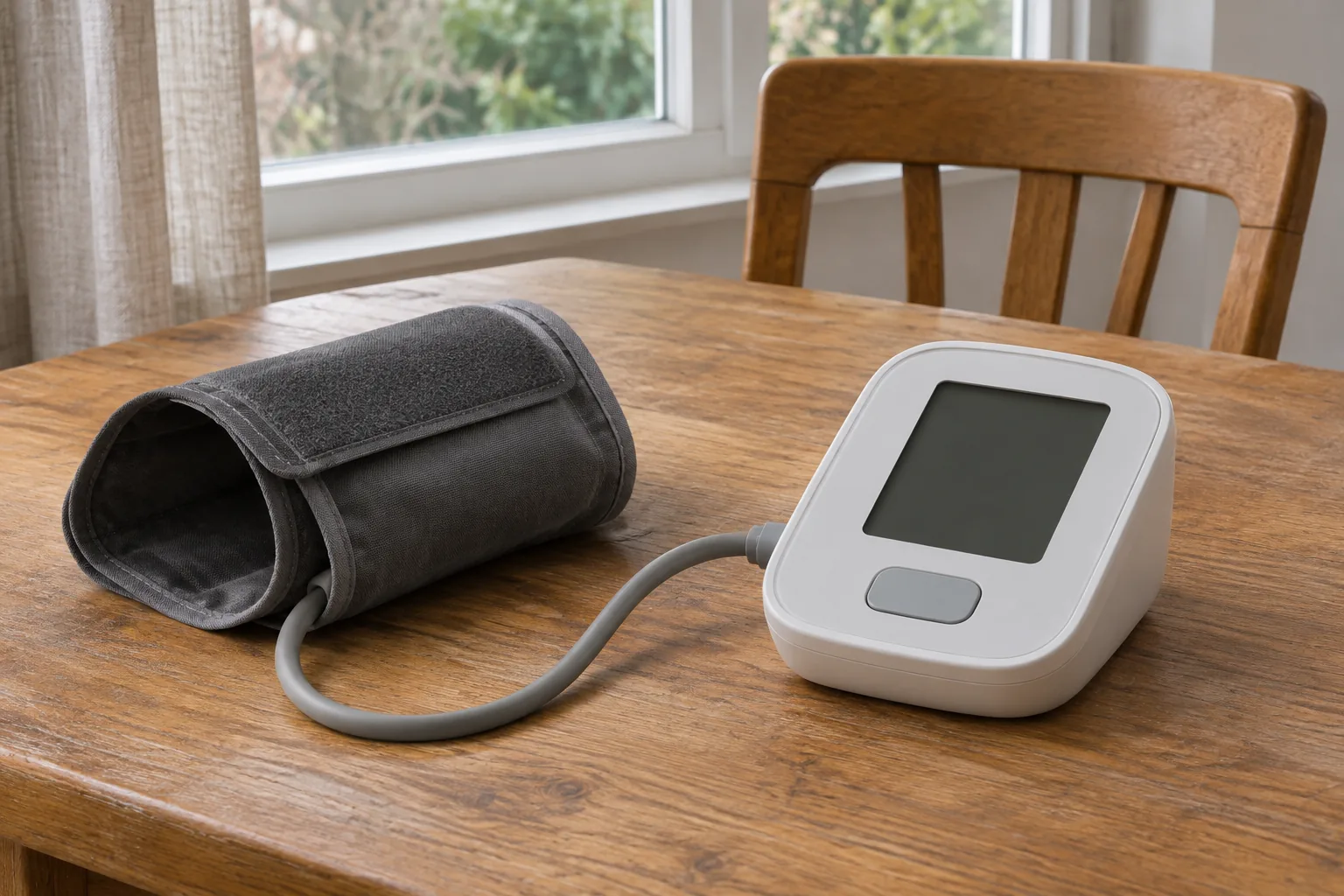
Imagine checking your blood pressure at the kitchen table. For the first reading, your hand rests in your lap. For the next, you put it on the table. The numbers change. Which one belongs in the log?
An automatic monitor gives you a crisp, precise-looking pair of numbers. But it can't see how you're sitting, and it doesn't correct for it. So the useful question starts before the screen lights up: where is the cuff, and what's holding your arm up?
Your cuff measures at the height where it sits
Blood is a fluid, and in any column of fluid, gravity makes the pressure higher the lower you go. You've felt this in a swimming pool: the deeper you dive, the more your ears feel the water pressing. Your arm works the same way. When the cuff sits below your heart, the height difference adds pressure at the arm, and the monitor counts it. When the cuff sits above your heart, the effect runs the other way. A University of Florida teaching resource explains this hydrostatic effect. The pool is only a comparison; your blood vessels aren't open water, but the gravity part is the same physics.
You don't need the equation to use the lesson. The target is the middle of the cuff at heart level, not simply “hand on a table.” A low table may support your arm while leaving the cuff too low. A pillow can help bring a resting arm to the right height, following the American Heart Association's positioning guidance.
Support solves another problem. Holding your arm in position yourself asks muscles to keep working, even when the arm looks still. That effort can raise blood pressure during the check. A clinical measurement review describes this muscle effect.
So "at heart level" and "supported" aren't two ways of saying the same thing. You need both. Lifting your arm to heart height and holding it there fixes the gravity part but adds the muscle part.
The same adults, three arm positions
The 2024 ARMS randomized crossover trial tested this everyday problem in 133 adults in Baltimore. Each person had measurements taken in different arm positions, using an automated monitor and trained staff. The reference setup was an arm supported on a desk with the middle of the cuff at heart level.
Compared with that setup, the study found these average differences:
- Hand supported in the lap: the top number was 3.9 points higher and the bottom number 4.0 points higher.
- Arm hanging unsupported at the side: the top number was 6.5 points higher and the bottom number 4.4 points higher.
The formal unit is millimeters of mercury, written mm Hg. The top number is systolic pressure; the bottom is diastolic pressure.
Those are group averages, not a correction to apply to your own reading. The trial also changed arm height and support together. It couldn't tell how much of each difference came from gravity versus muscle effort, and another device or setting may give different results.
What it does show is practical: the arm's position can change the result enough to deserve attention. “I used the same machine” doesn't mean “I took the measurement the same way.”
A cuff can fasten and still be the wrong size
The fabric closing around your arm isn't the whole fit check. Measure around your upper arm and compare that measurement with the cuff's stated size range, following the device instructions. Correct arm-circumference sizing is part of home-monitor guidance.
In the 2023 Cuff(SZ) randomized crossover trial, 195 adults had readings taken with an automated monitor and different cuff sizes. Using a regular cuff when a large cuff was needed raised the average top number by 4.8 mm Hg. When an extra-large cuff was needed, the regular cuff was two sizes too small, and the average top-number difference was 19.5 mm Hg.
The opposite error mattered too. For people who needed a small cuff, a regular cuff read an average 3.6 mm Hg lower on the top number. Bigger wasn't automatically better.
Individual effects varied, and these results came from one automated device under a research protocol. The authors cautioned that a simple numerical adjustment wouldn't fix everyone's result. Check the actual cuff range instead of adding or subtracting points.
Make one measurement spot you can use again
For the kitchen-table example, the first task isn't another round of guessing. Set up the chair, support and cuff before the next planned check. CDC's measurement guide and the AHA home instructions support this routine:
- Prepare. Avoid smoking, caffeine and exercise for 30 minutes beforehand, and empty your bladder.
- Settle into the chair. Rest quietly for at least five minutes. Support your back, put your feet flat on the floor, and keep your legs uncrossed.
- Check the arm. Put the correctly sized cuff on bare upper-arm skin as instructed. Rest your arm on a flat support, with a pillow if needed, so the middle of the cuff is at heart level.
- Stay quiet. Don't talk, use your phone or hold the arm up yourself during the measurement.
- Save the pair. Take two readings one minute apart and record both. Follow your care team's plan for how often to check; if monitoring daily, use the same time each day.
If an earlier reading used a different setup, note what happened rather than quietly deleting it. “Hand in lap” gives the care team more information than a number copied without context. It also keeps the log from becoming a collection of whichever results looked nicest.
You could bring this question to the free SageWiz health chat: “My blood pressure is higher with my hand in my lap. How should I support my arm and check cuff fit so my log is useful?”
Let the log show what happened
Bring the monitor and your readings to an appointment so the team can check your technique, cuff fit and how the device compares with office equipment. The AHA recommends checking the monitor this way.
Ask what pattern they want you to record and when to contact them about results. Don't change prescribed blood-pressure medicine because a home number looks better or worse. A log helps with clinical decisions; this article can't diagnose the reason for a difference.
If you need help getting the visit down to a few useful questions, the doctor visit checklist offers a simple way to organize them. If you're also sorting through a flagged blood test, what high and low lab flags mean explains a different kind of number that needs context.
Caveats
Technique isn't the only reason readings change. Recent activity, caffeine and nervousness can affect them too. High blood pressure also usually has no warning symptoms, so feeling fine isn't a reason to set aside repeated high results. CDC explains both the variation and the lack of symptoms.
This routine is for adult upper-arm home measurements. If you can't use the usual seated position or cuff, ask your care team for an adapted plan. Aim for consistent, recommended conditions, not the lowest possible number. An arm held above heart level isn't a clever workaround.
Curious how we research and check our articles? Read How SageWiz Researches and Checks Its Health Articles.
Evidence
A systematic review of 328 publications catalogued many sources of measurement error, including arm position and cuff size. Its search ended in 2015, before the two randomized trials discussed here. Those trials tested specific measurement conditions, not whether fixing a home setup prevents future heart problems.
The useful result is narrower and ready to use: make the next planned measurement repeatable. A supported arm, heart-level cuff and checked size give your log a clearer starting point.
Evidence used in this article
Primary sources and public health references reviewed for this article.
- Sources of inaccuracy in the measurement of adult patients’ resting blood pressure in clinical settings: a systematic review
Journal of Hypertension systematic review (2017)
Review of 328 publications, searches through June 2015; supports measurement setup as a source of variation, not the later trial numbers.
- Arm Position and Blood Pressure Readings: The ARMS Crossover Randomized Clinical Trial
JAMA Internal Medicine randomized crossover trial (2024)
133 adults; lap and hanging-arm positions gave higher mean readings than a supported arm with midcuff at heart level. Mechanisms were discussed but not isolated.
- Effects of Cuff Size on the Accuracy of Blood Pressure Readings: The Cuff(SZ) Randomized Crossover Trial
JAMA Internal Medicine randomized crossover trial (2023)
195 adults; a regular cuff read too low for arms needing a small cuff and too high for arms needing large/extra-large cuffs; individual effects varied.
- Blood pressure measurement: Part I—Sphygmomanometry: factors common to all techniques
BMJ clinical measurement review (2001)
Used narrowly for established arm-support physiology: holding an unsupported arm involves isometric muscle effort that can raise pressure. Current practical steps come from AHA/CDC.
- Home Blood Pressure Monitoring
American Heart Association patient guidance
Validated upper-arm monitor, arm-circumference cuff selection, rest and positioning, two readings one minute apart, log and device check; no medication changes.
- Measuring Your Blood Pressure
CDC patient guidance
Back supported, feet flat and legs uncrossed, arm/cuff at chest height, bare arm, quiet rest and recorded repeated readings; high pressure often has no symptoms.
- Simulation of Blood Pressure Measurement Hydrostatic Artifact
University of Florida Health academic teaching resource
Explains how vertical distance between cuff and heart adds a gravity-dependent pressure component; a teaching model, not patient outcome evidence.
- When To Call 911 About High Blood Pressure
American Heart Association urgent-care guidance
For nonpregnant adults, very high readings and associated symptoms need urgent action; do not keep checking positions or wait for chat.
Common questions
Is supporting my hand enough if the cuff is still low?
No. Support and height are separate checks. Rest the arm so the middle of the cuff is at heart level; a pillow may help. Follow the monitor instructions and have your care team check the setup.
Can I subtract a few points from a reading taken with my arm down?
The trial differences are group averages, not a personal correction. Record what happened and use the recommended position for planned measurements. Do not dismiss a high result by subtracting an average.
How do I know whether my cuff is the right size?
Measure around your upper arm and match the measurement to the cuff’s stated range. Being able to fasten it is not enough. Bring the cuff and monitor to a visit to check fit and technique.
Should I record only the lower of two readings?
Record both readings, taken one minute apart, rather than selecting the lower one. Follow the monitoring and follow-up plan from your care team.