Slow Breathing for Stress: Why Bigger Breaths Aren’t the Goal
You've had one of those days. Someone says, kindly, "Just take a deep breath." So you do. You fill your lungs to the top, hold your shoulders up, and blow it all out. You do it again, and a third time, because it's supposed to help. Instead of calm, you get a slightly floaty head, and now you're wondering whether you're doing it wrong.
You might be. Not because breathing exercises are a myth, but because "deep" and "slow" got bundled together, and they aren't the same instruction.
Two dials, not one
The amount of air you move in a minute depends on two things: how many breaths you take and how big each one is. Physiologists put it plainly: minute ventilation is breathing rate multiplied by the size of each breath.
Think of it like drinking water through the day. What you drink depends on how many sips you take and how big each sip is. Cut back to fewer sips but make every one a giant gulp, and you can end up drinking just as much, or more. The same arithmetic applies to the amount of air moved: slowing your pace doesn't lower that amount if each breath grows to make up for it. That's where the water comparison ends. It can't tell you how much air your body needs or predict your blood carbon dioxide.
Some extra depth is normal when you slow down. Slower breathing usually comes with somewhat bigger breaths, and that's fine. The trouble starts when "deep" turns into "as big as I can manage."
Why too much air can make you feel worse
Your body makes carbon dioxide all the time, and breathing out carries it away. When you breathe more than your body needs, you clear it faster than it's made, and the level in your blood drops. MedlinePlus lists lightheadedness, dizziness and weakness among the symptoms that can follow.
That could explain the floaty head in the opening example. But dizziness has other causes, so the feeling alone can't tell you whether you're overbreathing. Stop the exercise if it happens; recurring symptoms and new or unexplained breathing problems need medical attention.
What happened when researchers changed one sentence
A small 2019 laboratory experiment with 46 healthy young adults tested exactly this. Everyone followed a sound that paced them at six breaths a minute for ten minutes: four seconds in, six seconds out. That's a typical slow-breathing exercise.
Half were also told to avoid breathing excessively deeply. The other half weren't.
Both groups lost some carbon dioxide during the exercise. But the group without the extra instruction lost about twice as much: the carbon dioxide in their breath fell by an average of 5.2 mm Hg, compared with 2.7 mm Hg in the group told not to overdo it. They also reported a small rise in the physical symptoms that go with overbreathing, and the group given the extra instruction had less of that rise.
Same slow pace, one extra sentence of advice, a measurably different result.
It's a narrow study: young, healthy volunteers, ten minutes in a lab, a modest symptom change, and no stress treatment being tested. The advice didn't improve mood in this experiment, and it reduced the carbon dioxide drop rather than preventing it. A slow breathing cue alone didn't prevent overbreathing in this group. Breath size wasn't directly measured, so the study couldn't confirm that it explained the difference between groups.
Does slow breathing help stress at all?
It seems to help a little, on average. A 2023 review that pooled 12 randomized trials with 785 adults found that people who practised breathwork reported somewhat less stress than people in comparison groups. The pooled effect was small to medium. None of the trials was rated at low risk of bias, and they tested a mix of techniques in different groups of people, so the finding is promising rather than settled.
What about the exact pace? A larger 2023 trial with 400 adults compared about 5.5 breaths a minute with a matched practice at 12 breaths a minute. Both groups did gentle, guided breathing for about ten minutes a day for four weeks. Stress scores improved by about three points in both groups, and the slower rhythm did no better than the ordinary one.
That trial had no group that did nothing, so it can't show how much of the improvement came from the breathing itself. But it's a useful reality check: this trial didn't find a stress benefit from the slower pace. You don't need to force a six-breath count to follow the NHS routine below.
How to try it
This is a simple version based on NHS guidance for breathing exercises for stress. It's for an adult who is breathing normally and wants a calming habit.
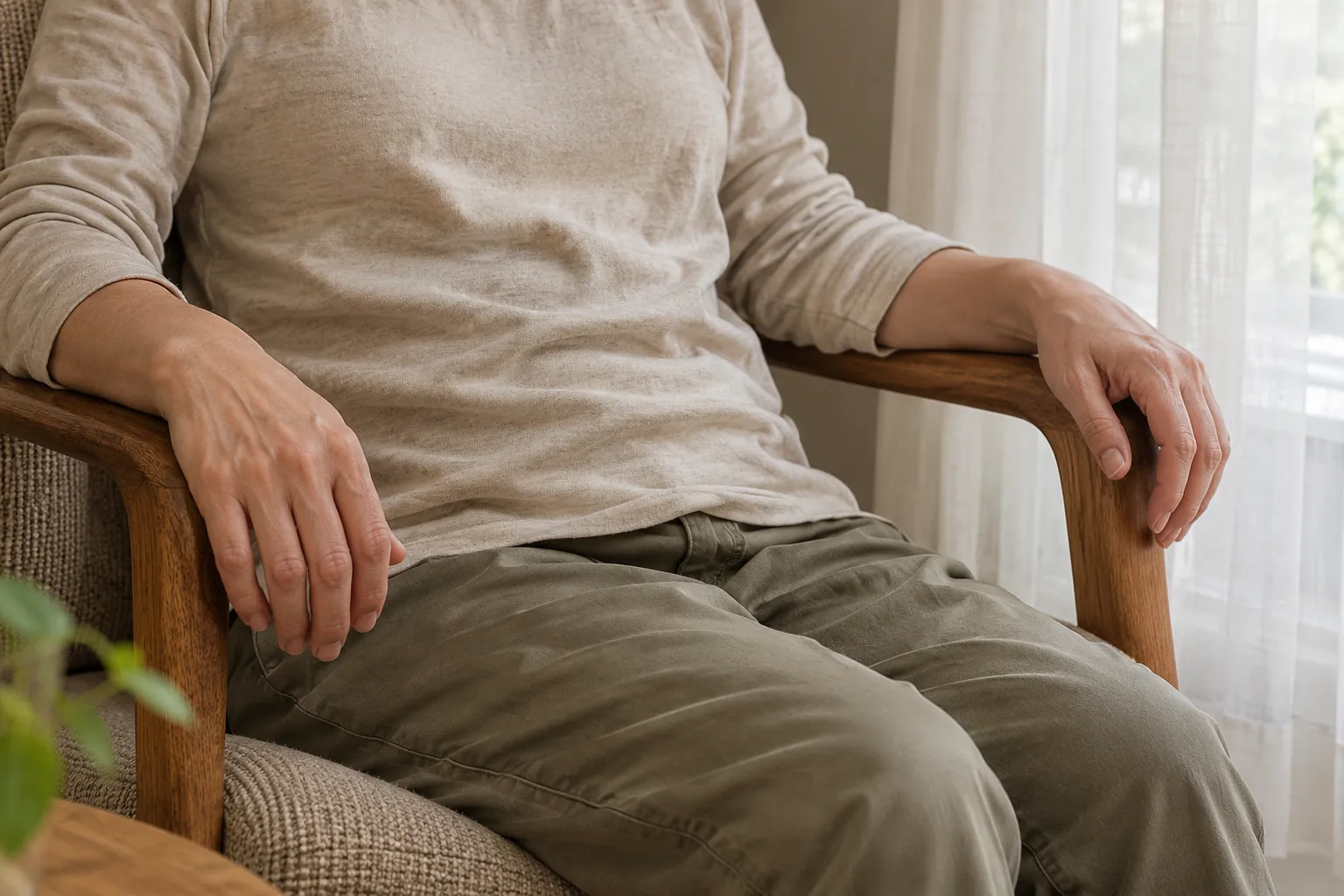
- Get comfortable. Sit in a chair that supports your back, feet flat on the floor and arms resting. Loosen anything tight around your waist or chest.
- Let the breath move into your belly, without forcing it. Breathe in gently through your nose and out through your mouth. Your breaths can get a little bigger as you slow down; they just shouldn't strain.
- Count if it helps. You can count steadily from one to five on the way in and again on the way out. If five feels like too much, use a shorter count. The count is a guide, not a target to hit.
- Keep it going for a few minutes. The NHS suggests at least five minutes. Comfort comes first, so stop sooner if you need to.
- Stop if you feel dizzy or lightheaded. The American Heart Association says to stop any breathing technique if that happens. Don't push on to reach a count.
If you have a heart or lung condition, the same AHA guidance says to check with your health care professional before trying breathing techniques. And keep any prescribed treatment exactly as it is.
If a breathing exercise keeps making you lightheaded, or you're not sure whether your breaths are too big, the free SageWiz health chat can help you think it through. For example: "I slow my breathing but make every breath very big, and I get lightheaded. What should I change?" The chat is educational and for adults 18 and over in the US.
When it isn't about technique
If lightheadedness or other symptoms keep coming back, write down when they happen and what you were doing, and take that to a clinician rather than deciding the cause yourself. Our doctor visit checklist can help you organize those notes. And if you're also tired all the time and your tests came back normal, here's what normal blood tests can and can't rule out.
Caveats
This article is about a calming habit for adults who are breathing normally. It isn't a treatment for anxiety, panic or any breathing condition, and it doesn't cover breath holds, fast-breathing techniques or the deliberately tiny breaths some methods teach. The main experiment was small and short and involved healthy young volunteers, so it tests one instruction rather than proving why an individual's symptoms happen.
So next time someone tells you to take a deep breath, take a slow one instead, and let it be a comfortable size.
Curious how we research and check our articles? Read How SageWiz Researches and Checks Its Health Articles.
Evidence
The physiology review explains why breath rate and breath size both set how much air you move. The 2019 experiment found a smaller carbon dioxide drop with advice against excessive depth, but it did not directly measure breath size and was small, short and done in healthy young adults. The 2023 review suggests breathwork may modestly reduce reported stress, with real uncertainty about study quality. The 2023 trial found no added benefit from a slower pace over an ordinary one, without an untreated comparison group. The NHS, American Heart Association and MedlinePlus pages supply the practical steps and safety limits.
Evidence used in this article
Primary sources and public health references reviewed for this article.
- An Anti-hyperventilation Instruction Decreases the Drop in End-tidal CO2 and Symptoms of Hyperventilation During Breathing at 0.1 Hz
Applied Psychophysiology and Biofeedback randomized laboratory experiment (2019)
46 healthy young adults paced at six breaths a minute; advice to avoid excessively deep breaths roughly halved the drop in exhaled carbon dioxide. Small, short and not a stress-treatment trial.
- Effect of breathwork on stress and mental health: A meta-analysis of randomised-controlled trials
Scientific Reports systematic review and meta-analysis (2023)
12 randomized trials, 785 adults; small-to-medium pooled reduction in self-reported stress, with no trial at low risk of bias.
- Effect of coherent breathing on mental health and wellbeing: a randomised placebo-controlled trial
Scientific Reports randomized controlled trial (2023)
400 adults; about 5.5 breaths a minute did no better than a matched 12-breath practice on stress over four weeks. No untreated control group.
- The physiological effects of slow breathing in the healthy human
Breathe (European Respiratory Society) physiology review (2017)
Explains that air moved per minute is breathing rate multiplied by breath size.
- Breathing exercises for stress
NHS self-help guidance
A comfortable, unforced breathing routine with an optional count.
- Hyperventilation
MedlinePlus medical encyclopedia
Why breathing more than you need lowers carbon dioxide, its symptoms, and when overbreathing needs medical care.
- Stress Management
American Heart Association guidance
Stop a breathing technique if dizzy or lightheaded; heart or lung conditions need professional advice first.
- When to use the emergency room - adult
MedlinePlus patient instructions
Adult symptoms that need 911 or emergency care, including severe chest pain or severe shortness of breath.
Common questions
Why do deep breaths make me lightheaded?
Breathing more air than your body needs can lower the carbon dioxide in your blood, which can cause lightheadedness or dizziness. Big breaths, even slow ones, can do that. Stop the exercise if it happens, and talk to a clinician if lightheadedness keeps coming back.
Is slow breathing the same as deep breathing?
No. Pace is how many breaths you take a minute; depth is how big each breath is. Your breaths can grow a little as you slow down, but they don't need to be as big as possible.
Do I need to breathe exactly six times a minute?
No. In a 2023 trial of 400 adults, about 5.5 breaths a minute did no better for stress than a matched practice at 12 breaths a minute. The trial did not test every breathing pace. The NHS routine uses a comfortable count if helpful, without a required six-breath target.
Who should check with a clinician before trying breathing exercises?
People with a heart or lung condition should ask their health care professional first. New, severe or unexplained breathing problems need medical care, not a breathing exercise.