Gallbladder Sludge and Digestion: The Missing Piece Wasn’t Another Food Rule
A SageWiz story about gallbladder sludge symptoms after fatty meals, digestive urgency, upper back discomfort, bile digestion, food anxiety, and calmer meals.
By SageWiz Editorial
Free next step
Reading this because something feels off?
Run a 2-minute Quick Check to organize symptoms, timing, safety flags, and clinician questions. Educational only; not a diagnosis.
For privacy, I’ll call her Maya.
Maya found SageWiz after months of trying to understand why her digestion had become so unpredictable. Some mornings started with stiffness before she even got moving. Her back would ache in a dull, frustrating way that made her wonder if she had slept wrong, trained too hard, eaten the wrong thing, or missed something bigger.
Then the digestive urgency would start. She had to think about where she was going, how far she would be from a bathroom, and what she had eaten the night before. When gallbladder sludge showed up on an MRI, the food questions got louder. Fattier meals were the ones that made her most nervous. Eggs cooked in butter, avocado, olive oil, a richer dinner out, or even foods that looked healthy on paper could feel like a gamble.
If you have ever searched for gallbladder sludge, fatty meals, upper back pain, morning urgency, or digestion that feels worse after rich food, you probably know the mental loop. You start thinking about food before you eat it. You wonder if the meal will be fine, if it will send you to the bathroom, if your back will hurt tomorrow, whether you should skip it, whether you should take something with it, and how to get through the day if it goes badly.
That distinction matters because people with digestive symptoms are often told the problem is just stress. That was not Maya’s story. Pain is real. Urgency is real. Stiffness is real. A medical finding on an MRI is real. The useful question was not whether this was all in her head. It was why meals had become so disruptive and what could make them easier to move through.
The gallbladder piece mattered
Gallbladder sludge is not imaginary. Medical reviews describe it as material that settles out of bile, often involving cholesterol crystals, calcium bilirubinate, and other salts. Sometimes it clears. Sometimes it comes and goes. Sometimes it can be associated with gallstones, biliary colic, pancreatitis, or cholecystitis.
When symptoms show up around fattier meals, it makes sense to think about bile and gallbladder function. Fat digestion asks more of that system. Some people also notice discomfort that seems to wrap into the back or shoulder area, nausea, bloating, or a sudden need to use the bathroom. Symptoms like severe pain, fever, vomiting, yellowing of the skin or eyes, dark urine, pale stools, unexplained weight loss, or worsening digestive urgency should be reviewed with a clinician.
But Maya’s day to day experience was bigger than a gallbladder finding on paper. It was a whole pattern that was starting to affect how she lived. She had already tried herbs, acupuncture, a low histamine diet, a low oxalate diet, removing fatty foods, adding ox bile, and easing up on intense workouts. Each idea made sense on its own. Fat might matter. Histamine might matter. Oxalates might matter. Stress, workouts, bile support, and inflammation might matter too.
After a while, the theories started piling up. Food became less simple, and Maya needed help seeing which clues actually belonged together.
What SageWiz helped her see
At that point, Maya was not looking for a diagnosis from a website. She needed a clearer way to organize what was happening in her body: gallbladder sludge, fatty meals, morning urgency, back pain, stiffness, ox bile, diet experiments, acupuncture, workout intensity, uncertainty around meals, and nervous system support.
SageWiz gave her a way to look at those clues together instead of forcing her to choose one explanation. The pattern around the meal itself started to stand out.
Maya realized she had been treating food like another task to get through. She was multitasking while eating, rushing, and moving on to the next thing before her body had caught up with the meal in front of her. For someone with a sensitive digestive system and unpredictable symptoms after meals, that pace mattered.
Her biggest insight was that reducing multitasking while eating made a real difference. She did not need the advice to be abstract or spiritual. She needed something practical: sit down, slow down, chew, stop rushing toward the next task, and give her body a calmer start.
There is a biological reason this idea is worth taking seriously. Digestion does not begin only when food hits the stomach. The smell, taste, sight, and anticipation of food can trigger what researchers call cephalic phase responses. In plain English, the body starts preparing for food before the food fully arrives. Saliva, stomach acid, pancreatic secretions, gut hormones, motility, and vagus nerve signaling can all be part of that early “food is coming” response.
This does not mean slow eating treats gallbladder sludge. It means the state you bring to a meal can influence the digestive environment. For Maya, that was the useful insight. She could not control everything, but she could change how meals started.
Warmth helped her stop rushing
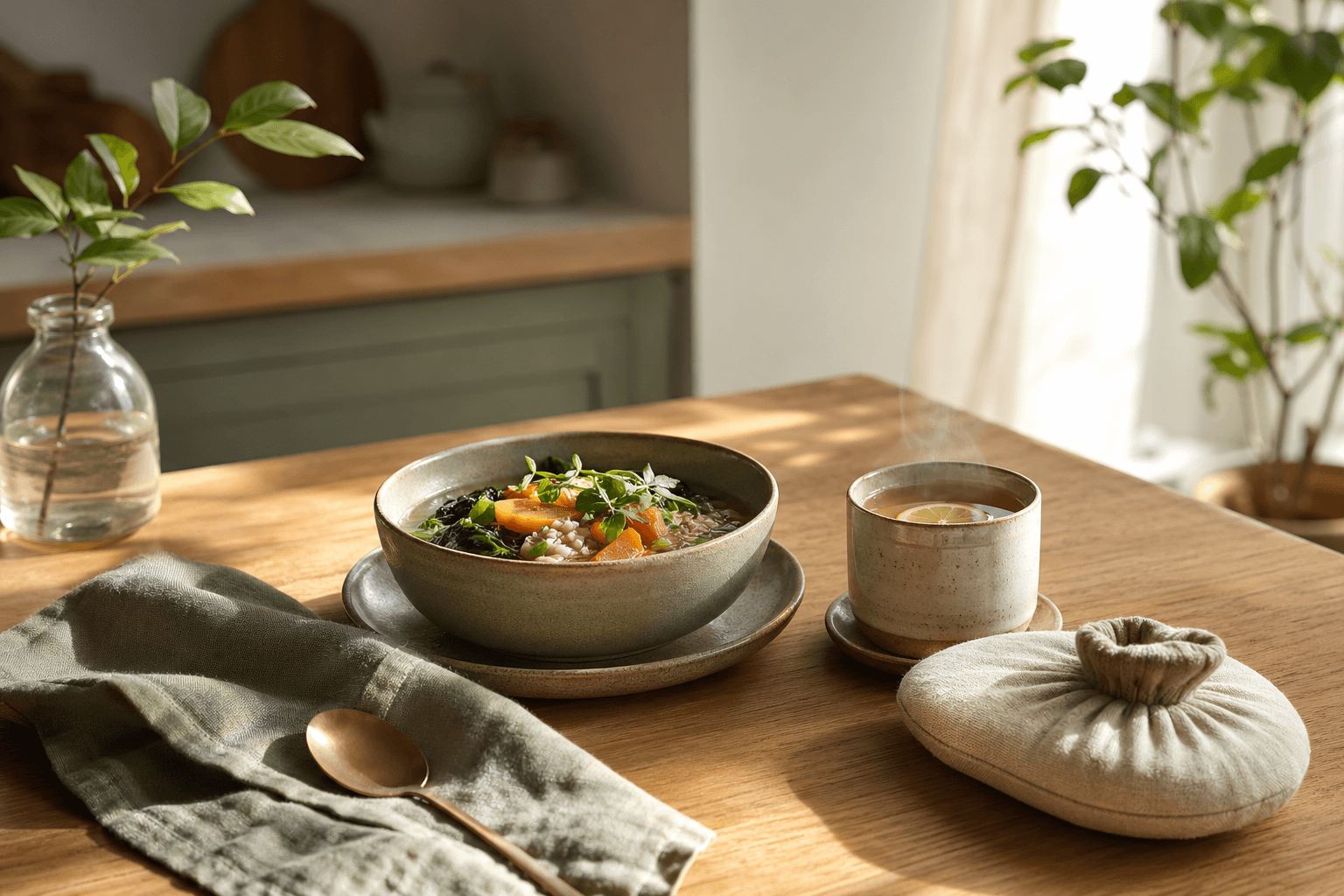
One of the most useful changes was making meals feel warmer and slower from the beginning. For Maya, that meant simple things like choosing warm foods, drinking ginger tea, and using a heat pack over her abdomen before or around meals. She also found infrared sauna and red light therapy helpful as part of her broader routine.
The point was not that any one tool solved everything. The warmth gave her a practical way to pause. Tea slowed the first few minutes of the meal. A heat pack helped her sit still instead of rushing into the next task. A calmer start made food feel less like something she had to get through and more like something her body could receive.
That change was subtle, but it was practical. It reduced the sense that every meal needed to be managed, restricted, or second guessed.
What changed for Maya
Once she started applying that advice, Maya became more present at meals. She slowed down, chewed more thoroughly, and tried to focus on peaceful or pleasant thoughts instead of rushing through the meal and immediately moving on.
She noticed her satiety signals more clearly. She tended to overeat less often. She felt more peaceful and relaxed while eating. That is not a miracle cure story, and it should not be framed that way. It is a more realistic kind of progress: she started trusting meals a little more.
Research makes her experience feel less random. Slow eating and more oral processing, including chewing, can influence satiation and food intake for some people. Mindful eating research should not be oversold, but the basic idea is reasonable: when you pay attention to eating, you may notice the body’s signals sooner.
The gut brain axis research also matters here, but not because it makes stress the cause. Stress, autonomic state, immune signaling, the microbiome, and digestion are connected. That research supports the idea that a calmer mealtime state can influence digestion, while still respecting that gallbladder findings and digestive symptoms are real medical issues.
Maya did not need a grand theory. She needed a practical way to make meals feel safer and less confusing.
What someone else can take from this
For someone in a similar position, the takeaway is simple: slow the pace of eating, chew thoroughly, and focus on peaceful or pleasant thoughts during meals, especially if meals have started to feel unpredictable or stressful.
That matters because once you have had enough bad meals, you can start carrying those experiences into the next one. You sit down already cautious. You eat while waiting for your body to react. You try to control the food harder, then harder again. Over time, that can make your world smaller. You avoid foods, but you may also start avoiding spontaneity, meals with other people, and trust in your own appetite.
This is the part that may be useful for someone else in the same loop. It is easy to think the next answer has to be one more restriction, one more supplement, or one more rule. They may still need a medical workup, labs, imaging, or a clinician’s help. But they may also need to consider whether the way food feels has become part of the pattern.
SageWiz helped Maya organize the messy middle. It did not diagnose her gallbladder condition from a chat, and it did not replace medical care. It helped her connect the dots she was already living with.
A simple experiment if you’re curious
If you see yourself in Maya’s story, do not copy every supplement, diet, or therapy she tried. Start simpler. For two weeks, keep your food mostly the same unless your clinician has told you otherwise, and make the meal itself calmer.
Sit down. Put your phone away for the first 10 minutes. Take a few slow breaths before the first bite. Start with something warm if that feels good, like tea or soup. Chew more than you normally do. Pause halfway through and ask, “Am I still hungry?”
Track what happens after meals: urgency, fullness, bloating, back discomfort, energy, ease, and whether you feel more in control. If nothing changes, that is useful information. If something changes, that is useful information too.
Common questions about gallbladder sludge and digestion
Can gallbladder sludge cause symptoms after fatty meals?
Gallbladder sludge can be silent. It can also show up in the middle of real symptoms that deserve medical context. If discomfort, nausea, bloating, digestive urgency, or upper back discomfort repeatedly appear after fatty meals or heavy meals, it is reasonable to ask a clinician whether bile flow, gallbladder function, gallstones, biliary sludge, or another digestive issue could be involved.
For Maya, the helpful part was not turning every symptom into a gallbladder diagnosis. It was noticing that fatty meals, digestive urgency, food anxiety, and the way she entered each meal were all part of the same lived pattern.
Can gallbladder issues cause digestive urgency or loose stools?
Digestive urgency and loose stools can have many causes, including infections, IBS, inflammatory conditions, medication changes, food reactions, bile acid issues, and other gut problems. But if bowel urgency keeps showing up after richer or fattier meals, it is worth bringing that pattern to a clinician instead of guessing alone.
The practical question is not, “Is this definitely my gallbladder?” The better question is, “What keeps happening after meals, and what medical or lifestyle clues should I track?”
Why can upper back or shoulder discomfort matter with gallbladder symptoms?
Gallbladder and bile duct symptoms are often discussed around upper right abdominal pain, especially when pain follows heavy meals. Some people also describe discomfort that seems to refer toward the back or shoulder area. That does not prove the gallbladder is the cause, but it is a symptom pattern worth taking seriously when it is severe, persistent, worsening, or paired with nausea, vomiting, fever, jaundice, dark urine, pale stools, or unexplained weight loss.
Does slow eating treat gallbladder sludge?
No. Slow eating, chewing, warmth, and calmer meals do not treat gallbladder sludge. Maya’s story is more specific than that. Slowing down helped her reduce the stress around meals, notice fullness earlier, and understand which parts of the pattern she could influence while still respecting that gallbladder findings belong in medical care.
Related SageWiz reading
- If your symptoms also involve itchy rashes, flushing, high histamine foods, or heat flares, read The 18-Month Rash: A Histamine Pattern Hiding in Plain Sight.
- If cravings, bloating, weight loss plateaus, or aches seem tied to diet soda or sweetened “zero sugar” products, read Why Diet Drinks May Be Sabotaging Your Gut Health and Weight Loss.
What this does not mean
This story should not be read as advice to ignore gallbladder symptoms.
Gallbladder and bile duct issues can become serious. A calmer meal is not a substitute for medical care. Maya’s story is not a prescription. It is one person’s experience with finding a more useful way to understand her symptoms.
Evidence
Evidence used in this article
Primary sources and public-health references reviewed for this draft.
- Gallbladder sludge: what is its clinical significance?
Current Gastroenterology Reports / PubMed
Review describing biliary sludge composition and variable clinical significance.
- Biliary sludge
Annals of Internal Medicine / PubMed
Clinical review describing biliary sludge components and possible clinical course.
- Cephalic reflexes: their role in digestion and possible roles in absorption and metabolism
Nutrition Reviews / PubMed
Review of cephalic phase digestive responses and vagal pathways.
- Nutritional implications of cephalic phase gastrointestinal responses
Appetite / PubMed
Review describing early digestive responses including motility, secretions, and gut hormones.
- Mindful Eating, Stress, Digestion, and Mindfulness Review
Integrative Medicine / PMC
Review discussing mindful eating, stress physiology, parasympathetic tone, and digestive function.
- Influence of oral processing on appetite and food intake - A systematic review and meta analysis
Appetite / PubMed
Systematic review and meta analysis on slow eating, oral processing, appetite, and satiation.
- Stress & the gut brain axis: Regulation by the microbiome
Neurobiology of Stress / PMC
Review of stress related gut brain axis signaling and microbiome involvement.
- Symptoms & Causes of Gallstones
NIDDK / NIH
Patient education page describing gallbladder attacks, heavy meals, bile duct blockage, and urgent warning symptoms.
- Eating, Diet, & Nutrition for Gallstones
NIDDK / NIH
Patient education page on diet patterns discussed in gallstone prevention and digestive health context.
Bottom line
Maya came to SageWiz looking for a deeper understanding of gallbladder sludge, fatty meals, digestive urgency, stiffness, back pain, and nervous system support.
What she found was not another harsh rule. It was a calmer way to see the pattern. Her meals needed less rushing, less multitasking, more warmth, more chewing, and more peace.
If food has started to feel unpredictable or overcomplicated, that kind of simplicity can matter. And if her anonymous story helps one other person stop blaming themselves and look at the whole pattern with more clarity, it was worth sharing.
Free Quick Check
Loading the article Quick Check…
No account is needed to start. If symptoms are severe, sudden, or rapidly worsening, seek urgent medical care instead of waiting for an online tool.